Subject-Verb Agreement: Complete Guide with 54 Rules & 50 Practice Questions [2025]
Master subject-verb agreement with this comprehensive guide featuring 54 detailed grammar rules, hundreds of examples, and 50 practice questions with answers. Perfect for BCECE-LE 2025, competitive exams, students, and professionals.

Master Subject-Verb Agreement: Your Complete Guide with 54 Rules & 50 Practice Questions
Have you ever wondered why some sentences just "sound wrong" even when you can't pinpoint the exact error? The answer often lies in subject-verb agreement – one of the most fundamental yet frequently misunderstood aspects of English grammar.
Subject-verb agreement is the grammatical rule that ensures the subject and verb in a sentence match in number (singular or plural) and person. While the basic concept seems simple – singular subjects take singular verbs, and plural subjects take plural verbs – the reality is far more nuanced.
Why is Subject-Verb Agreement Important?
Mastering subject-verb agreement is crucial for several reasons:
Academic Success: Proper grammar is essential for writing essays, reports, and research papers
Professional Communication: Emails, proposals, and business documents require flawless grammar
Competitive Exams: Tests like BCECE-LE, TOEFL, IELTS, SAT, and GRE heavily test this concept
Clear Communication: Correct agreement ensures your message is understood without confusion
Credibility: Grammar errors can undermine your authority and professionalism
What Makes Subject-Verb Agreement Challenging?
Many students and even experienced writers struggle with subject-verb agreement because:
Indefinite pronouns (everyone, none, some) have confusing rules
Collective nouns (team, family, committee) can be singular or plural
Phrases between subject and verb create confusion
Special constructions like "either...or" and "neither...nor" require specific rules
Some nouns look plural but are actually singular (news, mathematics, physics)
What You'll Learn in This Comprehensive Guide:
This complete guide provides everything you need to master subject-verb agreement:
✅ 54 Detailed Rules – From basic to advanced, covering every possible scenario ✅ Hundreds of Examples – Real-world sentences demonstrating each rule ✅ 50 Practice Questions – Test your understanding with answers provided ✅ Clear Explanations – Each rule explained in simple, easy-to-understand language ✅ Quick Reference Summary – Perfect for last-minute revision before exams
Whether you're a student preparing for BCECE-LE 2025, a professional looking to polish your writing skills, or an ESL learner working to improve your English, this guide will transform your understanding of subject-verb agreement.
SUBJECT-VERB AGREEMENT
BCECE – LE TECHNICAL ENGLISH [BCECE – LE 2026]
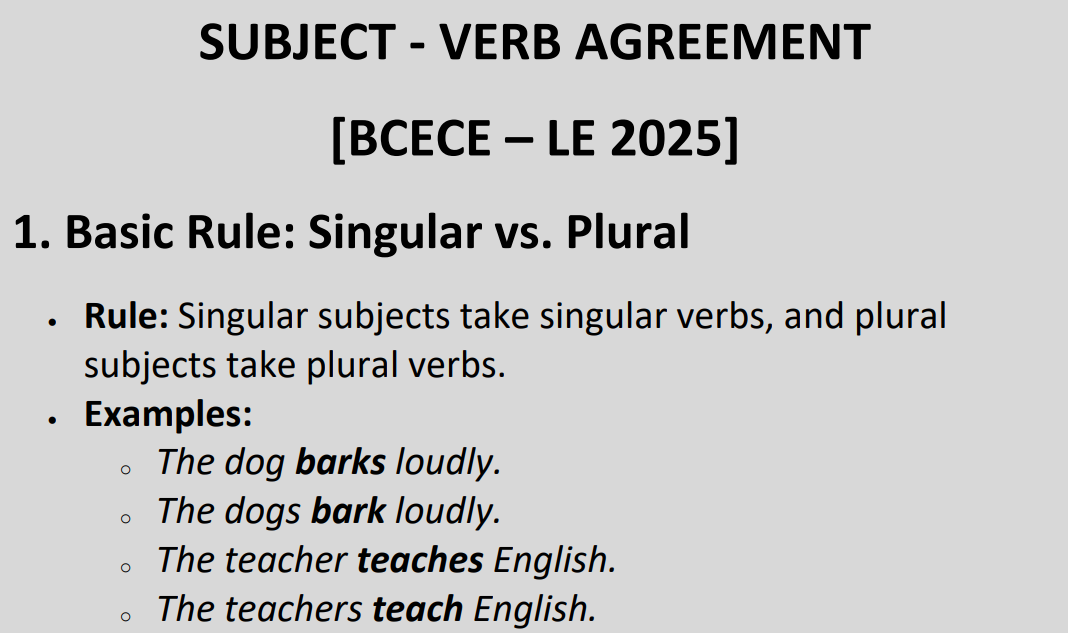
Rule 1: Basic Rule - Singular vs. Plural
Rule: Singular subjects take singular verbs, and plural subjects take plural verbs.
Examples:
The dog barks loudly.
The dogs bark loudly.
The teacher teaches English.
The teachers teach English.
A bird flies high.
Rule 2: Compound Subjects Joined by "and"
Rule: When subjects are joined by "and," use a plural verb.
Examples:
The boy and the girl are here.
The teacher and the principal have arrived.
Bread and butter make a great breakfast.
Tom and Jerry fight often.
Joy and happiness fill the room.
Exception:
If the compound subject refers to a single entity, use a singular verb.
Example:
Peanut butter and jelly is my favourite sandwich.
Rule 3: Subjects Joined by "Either...or" or "Neither...nor"
Rule: When subjects are joined by "or" or "nor," the verb is used according to the subject closest to it.
Examples:
Either the cat or the dogs are outside.
Neither the boys nor the girl was late.
Either the teacher or the students have to leave.
Neither the players nor the coach was ready.
Either he or they are responsible.
Rule 4: Indefinite Pronouns
Rule: Some indefinite pronouns are always singular (each, everyone, someone), while others are plural (many, few, several).
Singular Indefinite Pronouns
Always Singular: Each, everyone, someone, anybody, nobody, one, either, neither, much, little
Examples:
Each student has submitted their assignment.
Everyone is excited about the trip.
Someone left their umbrella in the classroom.
Does anybody know the answer?
Nobody likes to be ignored.
One should always do their best.
Either option is fine with me.
Neither of the answers is correct.
Much has been said about the topic.
Little is known about the history.
More Examples (Singular):
Everyone loves pizza.
Someone is waiting outside.
Each of the students has a book.
Everybody enjoys a holiday.
One of them is missing.
Plural Indefinite Pronouns
Always Plural: Many, few, several, both, all, most, these, those
Examples:
Many are interested in learning new skills.
Few have completed the assignment on time.
Several are planning to attend the concert.
Both have expressed their opinions on the matter.
All are welcome to join the discussion.
Most of the students have passed the exam.
These are the best cookies I've ever tasted.
Those are my favourite shoes.
More Examples (Plural):
Many were disappointed.
Few have arrived.
Several are missing.
Both know the answer.
Few were chosen.
Indefinite Pronouns that Can Be Singular or Plural
Can Be Either: None, all, most, some
Examples:
Singular Use:
None of the information is correct.
All of the cake is gone.
Most of the milk was spilled.
Some of the cake is left.
Plural Use:
None of the students were absent.
All of the cookies were eaten.
Most of the players have arrived.
Some of the players are injured.
Summary of Indefinite Pronouns
Always Singular: Each, everyone, someone, anybody, nobody, one, either, neither, much, little
Always Plural: Many, few, several, both, all, most, these, those
Can Be Singular or Plural: None, all, most, some
Rule 5: Collective Nouns
Definition: Collective nouns refer to a group of individuals or things treated as a single entity. Examples include "team," "group," "family," "audience," and "committee." The verb form depends on whether the collective noun acts as a single unit or if the members are acting independently.
Rule:
Singular Verb: Use a singular verb when the collective noun is acting as one unit.
Plural Verb: Use a plural verb when emphasizing the individuals within the group acting separately.
Singular Examples
The team is winning.
Explanation: The team (as one entity) is performing well in the game.
The jury has reached a verdict.
Explanation: The jury collectively made a decision.
The committee decides tomorrow.
Explanation: The committee will make a decision together as a unit.
The family is going on vacation.
Explanation: The family (as a single group) is taking a trip together.
The crowd was silent.
Explanation: The crowd acted as a single unit in remaining quiet.
Plural Examples
The team are wearing their uniforms.
Explanation: The individual members of the team are each wearing their own uniforms.
The jury are arguing with each other.
Explanation: The members of the jury are having a disagreement among themselves.
The committee have different opinions.
Explanation: The individual members of the committee hold different views.
The family are taking separate trips.
Explanation: Each member of the family is going on a different vacation.
The crowd were cheering individually.
Explanation: Each person in the crowd is cheering on their own, rather than as a unified group.
Summary
When a collective noun acts as a single entity, use a singular verb.
When the focus is on the individual actions of the members of the group, use a plural verb.
Rule 6: Nouns that Are Singular in Meaning but Plural in Form
Rule: Certain nouns may look plural because they end in "-s," but they are actually singular in meaning and take a singular verb. These nouns usually refer to fields of study, diseases, or collective ideas.
Categories:
Fields of Study: Mathematics, economics, physics, statistics, linguistics, psychology, sociology, philosophy, gymnastics, politics, ethics, billiards, athletics, civics, tactics
Diseases: Diabetes, measles, mumps, rickets, pneumonia
Uncountable Collective Concepts: News, ethics, politics, athletics, surveillance, information, arts, folkways
Examples:
Mathematics is difficult.
The news was surprising.
Economics requires understanding.
Statistics is a complex field.
Politics is often divisive.
Rule 7: Expressions of Amounts
Definition: Expressions of amounts refer to quantities or measurements that can be treated as either singular or plural depending on how they are perceived in the context of a sentence.
Rule:
Singular Verb: Use a singular verb when the amount is treated as one unit.
Plural Verb: Use a plural verb when the amount refers to multiple items or components.
Singular Examples
Ten dollars is enough.
Explanation: "Ten dollars" is viewed as a single amount of money.
Three miles is too far to walk.
Explanation: "Three miles" is treated as one distance to consider.
Half of the cake is gone.
Explanation: "Half" is viewed as a single portion of the cake.
Four weeks is a long time.
Explanation: "Four weeks" is considered one duration.
Twenty minutes is needed.
Explanation: "Twenty minutes" is viewed as one time frame required.
Plural Examples
Ten dollars were on the table.
Explanation: "Ten dollars" refers to individual bills or coins on the table, thus treated as plural.
Half of the cookies are gone.
Explanation: "Half" refers to multiple cookies that are no longer present.
Five kilometres were completed by different runners.
Explanation: "Five kilometres" refers to several kilometres completed by multiple individuals.
Two-thirds of the students are absent.
Explanation: "Two-thirds" refers to many students, thus treated as plural.
A quarter of the attendees were missing.
Explanation: "A quarter" refers to multiple attendees, so it takes a plural verb.
Summary
Singular usage: Treat the amount as a single unit (e.g., ten dollars is enough).
Plural usage: Treat the amount as referring to separate items or components (e.g., ten dollars were on the table).
Rule 8: Sentences Starting with "There" or "Here"
Rule: In sentences beginning with "there" or "here," the verb agrees with the subject that follows it.
Examples:
There is a book on the table.
There are many books on the shelf.
Here comes the bus.
There was a loud noise.
Here are the documents.
Rule 9: Subjects with "Each" or "Every"
Rule: When "each" or "every" precedes the subject, use a singular verb, even with compound subjects.
Words and Expressions that Require a Singular Verb:
Each, Every, Either, Neither, Anyone, Everyone, Someone, No one, Somebody, Any, Nobody, Each of, Every one of, Either of, Neither of, One, Either/or, Neither/nor
Examples for Each Word/Expression:
Each
Each student is responsible for their homework.
Explanation: "Each" refers to individual students, necessitating a singular verb.
Every
Every car needs an oil change.
Explanation: "Every" emphasizes individual cars, so the singular verb "needs" is used.
Either
Either option is acceptable.
Explanation: "Either" indicates one of two choices, thus requiring a singular verb.
Neither
Neither the teacher nor the students are late.
Explanation: "Neither" focuses on the individual subjects, so the singular verb "is" is used with the understanding that it refers to "neither...nor."
Anyone
Anyone can join the club.
Explanation: "Anyone" refers to any individual person, requiring the singular verb "can."
Everyone
Everyone loves a good story.
Explanation: "Everyone" refers to all individuals collectively, using the singular verb "loves."
Someone
Someone has left their umbrella.
Explanation: "Someone" refers to an unspecified individual, necessitating the singular verb "has."
No one
No one is perfect.
Explanation: "No one" emphasizes individuality, so the singular verb "is" is used.
Somebody
Somebody needs to answer the phone.
Explanation: "Somebody" refers to an individual, requiring the singular verb "needs."
Any
Any child can play in the park.
Explanation: "Any" refers to any single child, thus using the singular verb "can."
Nobody
Nobody knows the answer.
Explanation: "Nobody" refers to no individual, necessitating the singular verb "knows."
Each of
Each of the participants is excited.
Explanation: "Each of" focuses on individuals within a group, using the singular verb "is."
Every one of
Every one of the cookies is delicious.
Explanation: "Every one of" emphasizes individual cookies, requiring the singular verb "is."
Either of
Either of the books is interesting.
Explanation: "Either of" refers to one of two options, necessitating the singular verb "is."
Neither of
Neither of the answers is correct.
Explanation: "Neither of" emphasizes individuality, thus requiring the singular verb "is."
One
One of the dogs is barking.
Explanation: "One" refers to a single dog, necessitating the singular verb "is."
Either/or
Either the cat or the dog is misbehaving.
Explanation: In this construction, "either" refers to one of the two subjects, requiring a singular verb.
Neither/nor
Neither the manager nor the assistant is available.
Explanation: "Neither/nor" connects the two subjects, but the verb remains singular.
Additional Examples:
Each boy and girl is present.
Every man and woman wants peace.
Each student has a book.
Every player receives a medal.
Each of them is capable.
Rule 10: Titles of Works and Names of Organizations
Rule: When you mention the title of a book, movie, song, or the name of an organization, treat it as a singular noun, even if the title sounds plural. This means you should always use a singular verb with these titles.
Examples:
The Chronicles of Narnia is popular.
Star Wars was a success.
The United Nations is meeting today.
The Simpsons is on TV tonight.
Harry Potter is loved worldwide.
Rule 11: "The Number of" vs. "A Number of"
Rule:
"The number of" takes a singular verb
"A number of" takes a plural verb
Examples:
The number of applicants is high.
A number of applicants have been selected.
The number of cases has increased.
A number of students are attending.
The number of people is impressive.
Rule 12: "One of Those Who..."
Rule: When using "one of those who," use a plural verb because it refers to "those."
Examples:
She is one of those people who enjoy reading.
He is one of those students who study hard.
I am one of those people who like pizza.
He is one of the players who have scored a goal.
She is one of those teachers who encourage creativity.
Rule 13: "None" Can Be Singular or Plural
Rule: The word "none" can be either singular or plural, depending on what you mean:
Singular Use: When "none" refers to "not one" or emphasizes the absence of a single item, use a singular verb.
Plural Use: When "none" refers to "not any" or emphasizes multiple items, a plural verb can be used.
Singular Examples
None of the money is missing.
Explanation: "None" means "not one (unit of money)," so we use the singular verb "is."
None of the cake was left.
Explanation: "None" refers to "not one piece of cake," requiring the singular verb "was."
None is available right now.
Explanation: "None" indicates "not one item is available," so we use the singular verb "is."
Plural Examples
None of the players are ready.
Explanation: "None" means "not any of the players," so we use the plural verb "are."
None of the answers were correct.
Explanation: "None" refers to "not any answers," so we use the plural verb "were."
None were found.
Explanation: "None" means "not any items were found," which calls for the plural verb "were."
Summary
When using "none," pay attention to what you are talking about:
If it's about one thing, use a singular verb.
If it's about multiple things, use a plural verb.
Rule 14: When Using "Who," "Which," or "That" Clauses
Rule: In relative clauses, the verb agrees with the noun to which the relative pronoun refers.
Examples:
She is one of the writers who have inspired many.
He is the only one of the team who knows the plan.
The book that contains these stories is popular.
I have friends who support my dreams.
He is one of those people who enjoy the outdoors.
Rule 15: Subjects with "Many a" or "Every"
Rule: Phrases beginning with "many a" or "every" take a singular verb, even if they sound plural.
Examples:
Many a student struggles with math.
Every man and woman wants peace.
Every house on this block needs repairs.
Many a soldier was honoured.
Every cat and dog has a collar.
Rule 16: "More Than One" Takes a Singular Verb
Rule: Despite seeming plural, "more than one" takes a singular verb.
Examples:
More than one student has failed the exam.
More than one car is needed.
More than one answer was correct.
More than one person knows the secret.
More than one dog is barking.
Rule 17: When "Majority," "Minority," and "Plurality"
Rule: These words can be singular or plural based on whether they refer to a group acting as one or as individuals.
Singular Examples
The majority believes this decision is right.
A large portion of the audience was quiet.
The minority disagrees with the proposal.
Plural Examples
A majority of voters disagree with the policy.
The minority of students are protesting.
The plurality of choices make it difficult.
Rule 18: Subjects in "Either...or" and "Neither...nor" Constructions
Rule: When subjects are joined by "either...or" or "neither...nor," the verb agrees with the nearest subject.
Examples:
Either the manager or the employees are attending.
Neither the students nor the teacher is ready.
Either the boys or the girl has the answer.
Neither the teacher nor the students were prepared.
Either he or they are correct.
Rule 19: Phrases with "As Well As," "Along With," and "Together With"
Rule: These phrases do not change the number of the subject; the verb agrees with the main subject.
Examples:
The teacher, as well as the students, is excited.
The manager, along with his assistants, plans the event.
The book, together with its sequel, is on the shelf.
The captain, as well as the crew, is prepared.
The CEO, along with the board members, attends the meeting.
Rule 20: When Using Fractions or Percentages
Rule:
When a fraction or percentage modifies a singular noun, use a singular verb.
When it modifies a plural noun, use a plural verb.
Singular Examples
One-third of the cake is eaten.
Fifty percent of the task is complete.
Two-thirds of the bottle was finished.
Plural Examples
Half of the students are present.
Seventy percent of people agree with the decision.
A third of the cookies were eaten.
Quick Review
Always identify the main subject and match it to the correct verb.
Watch for phrases like each, either/or, neither/nor, and expressions of quantity.
Remember that some subjects may look plural but are actually singular (e.g., news, mathematics).
Rule 21: With Gerunds and Infinitives as Subjects
Rule: Gerunds and infinitives used as subjects take singular verbs.
Examples:
Running is fun.
To swim requires strength.
Learning a language takes time.
Dancing is her passion.
To read a novel is relaxing.
Rule 22: Inverted Sentences
Rule: In sentences where the verb comes before the subject, make sure the verb agrees with the subject, not with any words that come before it.
Examples:
Around the corner is a bakery.
In the basket are apples.
There go the children.
On the hill stands a monument.
In the sky flies a kite.
Rule 23: Collective Amounts Like "Half," "A Third," and "A Quarter"
Rule: Collective amounts followed by a singular or plural noun determine whether the verb is singular or plural.
Singular Examples
Half of the pie was eaten.
A quarter of the cake is left.
Plural Examples
A quarter of the students are absent.
Half of the apples were bruised.
Three-quarters of the houses were damaged.
Rule 24: Subjects with "All," "Some," "More," or "Most"
Rule: Words like "all," "some," "more," and "most" take singular verbs when they refer to singular nouns and plural verbs when they refer to plural nouns.
Singular Examples
All of the cake is gone.
Some of the water is evaporated.
Plural Examples
All of the students are present.
Most of the books were returned.
Some of the apples are ripe.
Rule 25: "One of" Followed by a Plural Noun
Rule: When using "one of" followed by a plural noun, use a singular verb after "one of."
Examples:
One of the students is absent.
One of my friends has arrived.
One of the teachers knows the answer.
One of the chairs is broken.
One of the candidates was selected.
Rule 26: Subjects That Appear Plural but Are Singular in Meaning
Rule: Certain nouns appear plural but are treated as singular when they refer to a single item or concept, like news, measles, or mathematics.
Examples:
The news is surprising.
Mathematics is challenging for some.
Economics requires detailed study.
Physics is fascinating.
Linguistics is the study of language.
Rule 27: "A Pair of" Takes a Singular Verb
Rule: When using phrases like "a pair of," the verb agrees with the singular "pair."
Examples:
A pair of shoes is on the floor.
A pair of scissors is in the drawer.
A pair of glasses was found.
A pair of socks is missing.
A pair of trousers is hanging.
Rule 28: Titles of Books, Movies, and Works of Art
Rule: Titles of books, movies, and works of art take a singular verb, even if they are plural in form.
Examples:
"The Great Expectations" is a classic novel.
"The Chronicles of Narnia" is popular among readers.
"The Avengers" is a hit movie.
"The United Nations" was established in 1945.
"The Beatles" is a legendary band.
Rule 29: Amounts of Time, Money, or Distance
Rule: Amounts that refer to a total single unit take a singular verb, even if they are plural in form.
Examples:
Five dollars is enough.
Ten years is a long time.
Fifty miles is a long drive.
Twenty minutes is sufficient.
Two hundred dollars is a fair price.
Rule 30: Using "Every" and "Each" Before Nouns
Rule: When each or every is used with a noun, it requires a singular verb, even with compound subjects.
Examples:
Every student and teacher is here.
Each man, woman, and child has a ticket.
Every cat and dog needs care.
Each participant is eligible for a prize.
Every book and magazine was accounted for.
Rule 31: Units of Measurement or Quantities
Rule: When a noun refers to a measurement or quantity considered as a whole, use a singular verb.
Examples:
Two liters of water fills the tank.
Five kilos of rice costs a lot.
One gallon of milk is needed.
Three meters of cloth is enough.
A dozen eggs is in the basket.
Rule 32: Plural Nouns that Refer to a Single Item
Rule: Some nouns that are plural in form but refer to a single item take a singular verb.
Examples:
The news was announced yesterday.
Physics is difficult for many students.
Gymnastics is her favourite sport.
Ethics is important in every profession.
Statistics is required in many courses.
Rule 33: Relative Pronouns (Who, Which, That)
Rule: The verb following a relative pronoun (who, which, that) agrees with the noun preceding it.
Examples:
She is one of the people who work hard.
It is the only one of the products that needs improvement.
He is the kind of person who inspires others.
These are the rules that apply to everyone.
I am the one who makes decisions here.
Rule 34: Quantities - Collective Nouns that Can Be Singular or Plural
Rule: When referring to a collective noun, it may be singular or plural based on context.
Singular Examples
The committee decides today.
The team wins the game.
The audience applauds the actor.
Plural Examples
The committee are discussing their views.
The team celebrate their victory.
The audience clap for the performance.
Rule 35: "One of" Followed by a Plural Noun
Rule: When "one of" is followed by a plural noun, use a singular verb after "one of."
Examples:
One of the children is absent.
One of my friends lives here.
One of these books is rare.
One of the buildings was damaged.
One of the reasons is valid.
Rule 36: Subjects with "Any," "More," "Most," and "Some"
Rule: Words like any, more, most, and some can take either a singular or plural verb, depending on whether the noun they refer to is countable or uncountable.
Singular Examples
Some of the water was spilled.
Most of the information is outdated.
More of the cake is left.
Plural Examples
Some of the books are on the table.
Most of the students have finished.
More of the options are available.
Rule 37: When "What" or "All" Functions as the Subject
Rule: When what or all is used as the subject, the verb agrees with the intended meaning, either singular or plural.
Singular Examples
What matters is your effort.
All that remains is hope.
What bothers me is the noise.
Plural Examples
All are welcome here.
What cause delays are the traffic jams.
All belong to this community.
Rule 38: Titles of Businesses, Brands, or Organizations
Rule: Names of companies, organizations, or brands take a singular verb even if they sound plural.
Examples:
General Motors is launching a new model.
Microsoft has updated its software.
United Airlines offers great service.
Procter & Gamble is a large company.
Coca-Cola was founded over a century ago.
Rule 39: Singular Subjects Followed by "Of" Phrases
Rule: When a singular subject is followed by a phrase starting with "of," the verb should agree with the singular subject, not the object of the phrase.
Examples:
The bouquet of flowers is beautiful.
The sound of waves is soothing.
The price of groceries has increased.
The texture of these fabrics is soft.
The importance of these principles is clear.
Rule 40: When Using "A Number of" vs. "The Number of"
Rule:
"A number of" is treated as plural
"The number of" is treated as singular
Examples:
A number of students are attending the seminar.
The number of applicants is increasing.
A number of issues have been resolved.
The number of cars has decreased this year.
A number of friends are joining the trip.
Rule 41: Relative Pronouns with Plural Antecedents
Rule: When a relative pronoun like "who," "which," or "that" refers to a plural antecedent, the verb should agree with the plural noun.
Examples:
The teachers who work here are qualified.
The ideas that inspire change are powerful.
The people who support the cause are admirable.
The policies which govern this office are strict.
The writers who contribute to the blog are talented.
Rule 42: Compound Subjects Connected by "Not Only...But Also"
Rule: With compound subjects connected by "not only...but also," the verb agrees with the subject closer to the verb.
Examples:
Not only the manager but also the employees were present.
Not only the teachers but also the principal is attending.
Not only the books but also the laptop was left behind.
Not only the parents but also the child needs support.
Not only the singer but also the dancers perform well.
Rule 43: Subjects Preceded by "A Lot Of," "Plenty Of," "Most Of"
Rule: When phrases like "a lot of," "plenty of," and "most of" are used, the verb agreement depends on the noun that follows these phrases.
If the noun following the phrase is singular or uncountable, use a singular verb.
If the noun is plural, use a plural verb.
Common Words That Follow This Rule:
a lot of, plenty of, most of, some of, none of, all of, half of, a portion of, the majority of, a number of, a bit of, a couple of, a handful of, a fraction of, lots of, an abundance of, a series of, a variety of, a group of, the rest of, a percentage of
Singular Examples:
A lot of effort is required to complete this project.
Plenty of milk is needed for the recipe.
Most of the cake was eaten before the guests arrived.
Some of the water is left in the bottle.
None of the advice is useful in this situation.
Plural Examples:
A lot of people are joining the event.
Plenty of books were donated to the library.
Most of the students have submitted their assignments.
Some of the employees were late to the meeting.
All of the cookies are gone from the plate.
Rule 44: Collective Nouns as Plural in British English
Rule: In British English, collective nouns like "team" or "government" can take plural verbs, as they are treated as a collection of individuals. (In American English, these are generally singular.)
Examples (British English):
The team are celebrating their win.
The government have announced a new policy.
The family are moving to a new home.
Examples (American English):
The team is celebrating its win.
The government has announced a new policy.
The family is moving to a new home.
Rule 45: "The Majority of" Can Be Singular or Plural
Rule: "The majority of" can be singular or plural, depending on whether it refers to individuals or a single collective group.
Singular Examples:
The majority of the team is ready.
The majority of the work was completed.
Plural Examples:
The majority of voters have decided.
The majority of participants are excited.
The majority of the emails were sent.
Rule 46: "More Than One" Followed by a Plural Verb in Some Contexts
Rule: While "more than one" generally takes a singular verb, it can take a plural verb in informal usage or certain contexts.
Examples:
More than one person has commented. (formal/singular)
More than one participant were seen discussing. (informal/plural)
More than one student is absent today.
More than one friend was there.
Rule 47: Subjects Joined by "As Well As" or "Along With"
Rule: When two subjects are joined by as well as, along with, or similar phrases, the verb agrees with the first subject.
Examples:
The teacher, along with the students, was present.
The CEO, as well as the board members, approves the decision.
The dog, along with its puppies, is sleeping.
John, as well as his friends, enjoys hiking.
The manager, along with her team, has completed the project.
Rule 48: The Construction "The Only One of Those Who"
Rule: In phrases like "the only one of those who," use a plural verb after "who" because it refers to the plural noun before it.
Examples:
She is the only one of those students who have passed the exam.
He is the only one of the members who were nominated.
This is the only one of the books that contain the information.
You are the only one of the candidates who have experience.
She is the only one of the applicants who qualify for the job.
Rule 49: Relative Pronouns with Collective Nouns as Antecedents
Rule: When a relative pronoun (like "who" or "that") follows a collective noun, the verb can be singular or plural, depending on the emphasis on the group as a whole or as individuals.
Singular Examples:
The team that is winning deserves praise.
The family who lives here is friendly.
Plural Examples:
The team who are celebrating are thrilled.
The staff that are on duty have been working hard.
Rule 50: Collective Nouns with a Focus on Action by Members
Rule: When focusing on the members of a collective noun performing individual actions, a plural verb is used.
Examples:
The committee are arguing among themselves.
The jury were divided in their opinions.
The audience are clapping their hands.
The crew are preparing individually for the trip.
The orchestra are tuning their instruments.
Rule 51: Inverted Sentences Starting with "Here" or "There"
Rule: In sentences that begin with "here" or "there," the verb should agree with the true subject, which often comes after the verb.
Examples:
Here are the keys you lost.
There is a book on the table.
Here comes the train.
There were two dogs in the park.
Here are your files.
Rule 52: Indefinite Pronouns with Dependent Clauses
Rule: When an indefinite pronoun is followed by a clause that contains a plural noun, the verb still agrees with the singular pronoun, not the plural noun.
Examples:
Each of the students who has completed the assignment will receive credit.
Anyone who knows the rules can participate.
Everybody who wants to join is welcome.
Someone who reads often is more knowledgeable.
Anybody who has questions can ask.
Rule 53: Collective Nouns with Possessive Pronouns
Rule: When referring to a collective noun with possessive pronouns, the pronoun and verb can be plural if emphasizing the members individually.
Examples:
The jury gave their verdict after deliberating.
The family had their own opinions about the trip.
The crew share their stories with each other.
The team have their routines for the game.
The audience showed their appreciation.
Rule 54: Relative Pronoun "Which" Referring to the Entire Clause
Rule: When which refers to an entire preceding clause, the verb following which is typically singular.
Examples:
She failed the exam, which is unfortunate.
The storm caused delays, which was expected.
He bought a car, which is a great decision.
The event was cancelled, which is disappointing.
They moved to a new city, which is exciting.
Quick Reference Guide:
Always Singular:
Each, every, everyone, someone, anyone, nobody, one
News, mathematics, physics, economics (fields of study)
Measles, mumps, diabetes (diseases)
"The number of"
"More than one"
Gerunds and infinitives as subjects
"A pair of"
Titles of books, movies, organizations
Company/brand names
Always Plural:
Many, few, several, both
"A number of"
Compound subjects joined by "and"
Context-Dependent (Singular or Plural):
None, all, most, some
Collective nouns (team, family, jury, committee)
Fractions and percentages
Expressions of amount
"The majority of"
Special Rules:
Either/or, Neither/nor → verb agrees with nearest subject
Not only...but also → verb agrees with nearest subject
As well as, along with → verb agrees with first subject
Relative pronouns (who, which, that) → verb agrees with antecedent
"One of those who" → use plural verb
"The only one of those who" → use plural verb
Key Tips:
Identify the true subject of the sentence
Don't be confused by intervening phrases
Watch for inverted word order (here/there sentences)
Consider context for collective nouns
Remember: singular subjects take singular verbs, plural subjects take plural verbs
SUBJECT-VERB AGREEMENT PRACTICE QUESTIONS
Practice Questions with Answers
Question 1
Each of the players ____ (is/are) ready for the match.
Answer: is
Question 2
A number of students ____ (has/have) completed their assignments.
Answer: have
Question 3
The number of cars in the parking lot ____ (is/are) increasing.
Answer: is
Question 4
None of the cake ____ (was/were) left after the party.
Answer: was
Question 5
Either the teacher or the students ____ (is/are) responsible for the project.
Answer: are
Question 6
Everyone in the class ____ (has/have) a notebook.
Answer: has
Question 7
The jury ____ (has/have) reached its verdict.
Answer: has
Question 8
Neither the cat nor the dogs ____ (is/are) outside.
Answer: are
Question 9
Each student and teacher ____ (is/are) invited to the ceremony.
Answer: is
Question 10
The committee ____ (decides/decide) on the new policy tomorrow.
Answer: decides
Question 11
A pair of shoes ____ (was/were) found in the hallway.
Answer: was
Question 12
The news about the storm ____ (is/are) alarming.
Answer: is
Question 13
Five miles ____ (is/are) too far to walk.
Answer: is
Question 14
Both of the answers ____ (is/are) correct.
Answer: are
Question 15
None of the information ____ (was/were) useful.
Answer: was
Question 16
The team ____ (is/are) winning the game.
Answer: is
Question 17
A number of books ____ (has/have) been returned.
Answer: have
Question 18
The flock of birds ____ (is/are) flying south for the winter.
Answer: is
Question 19
Each of the girls ____ (has/have) a new dress.
Answer: has
Question 20
The couple ____ (was/were) very happy together.
Answer: was
Question 21
There ____ (is/are) many reasons to study.
Answer: are
Question 22
Neither of the answers ____ (is/are) correct.
Answer: is
Question 23
Everyone in the group ____ (has/have) a different opinion.
Answer: has
Question 24
Each boy and girl ____ (is/are) required to attend.
Answer: is
Question 25
A number of people ____ (is/are) waiting for the bus.
Answer: are
Question 26
The team ____ (has/have) its own unique style.
Answer: has
Question 27
The data ____ (was/were) analysed carefully.
Answer: was
Question 28
Both of the students ____ (was/were) present.
Answer: were
Question 29
None of the chocolate ____ (was/were) eaten.
Answer: was
Question 30
Either the manager or the employees ____ (is/are) to blame.
Answer: are
Question 31
A committee of experts ____ (is/are) meeting today.
Answer: is
Question 32
The number of applicants ____ (is/are) increasing each year.
Answer: is
Question 33
The flock of sheep ____ (is/are) grazing in the field.
Answer: is
Question 34
Many of the flowers ____ (is/are) blooming beautifully.
Answer: are
Question 35
Each of the teachers ____ (has/have) a different style.
Answer: has
Question 36
The police ____ (is/are) investigating the case.
Answer: are
Question 37
None of the equipment ____ (was/were) damaged in the storm.
Answer: was
Question 38
A group of students ____ (is/are) attending the conference.
Answer: is
Question 39
The crowd ____ (was/were) cheering loudly.
Answer: was
Question 40
Each dog and cat ____ (is/are) welcome in the park.
Answer: is
Question 41
Several of the reports ____ (is/are) due tomorrow.
Answer: are
Question 42
The team of engineers ____ (has/have) finished the project.
Answer: has
Question 43
The news from the front lines ____ (is/are) troubling.
Answer: is
Question 44
A variety of options ____ (is/are) available.
Answer: are
Question 45
Each person in the meeting ____ (has/have) a chance to speak.
Answer: has
Question 46
The class ____ (is/are) going on a field trip.
Answer: is
Question 47
The majority of the group ____ (has/have) decided to go.
Answer: have
Question 48
None of the facts ____ (is/are) relevant.
Answer: are
Question 49
The committee ____ (decides/decide) on the new rules soon.
Answer: decides
Question 50
Both of the solutions ____ (was/were) effective.
Answer: were
Practice Questions Summary
Total Questions: 50
Key Concepts Tested:
Indefinite pronouns (each, everyone, none, both, several, many)
"A number of" vs. "The number of"
Either/or and Neither/nor constructions
Collective nouns (team, committee, jury, crowd, flock)
Expressions of quantity and amount
Compound subjects with "and"
Inverted sentences with "there"
Special nouns (news, data, police)
Fractions and portions
"A pair of" constructions
Study Tips:
Review the rule that corresponds to each question type
Identify the subject before choosing the verb
Watch for tricky intervening phrases
Pay attention to singular vs. plural indefinite pronouns
Remember context matters for collective nouns